It Works… Until It Doesn’t
It works for a few days, sometimes a week, and then something shifts. The plan still makes sense. Nothing about it is obviously wrong. But the way you were moving through it—the clarity, the momentum, the follow-through—that part starts to slip. You skip one thing, then another. You adjust the plan, try to get back on track, maybe tighten things up a little. And even though the structure is still there, it doesn’t land the same way it did at the beginning.
This pattern shows up in a lot of different forms. You create a schedule that feels realistic, and for a few days, it actually is. You move through it, checking things off, staying focused, feeling like you finally found something that fits. Or you come across a system that seems to click, and there’s a sense of relief in that, like things might actually hold this time. But then, without anything major changing, it starts to fall apart. Not all at once, and not in a way that’s easy to point to. Just enough that it stops working the way it did.
It’s easy to interpret that as inconsistency. Like something about your ability to follow through isn’t stable, like you just need to find a way to maintain what was working. So the response becomes trying to recreate the conditions from the beginning. You reset the plan, reorganize it, approach it again with a little more effort, a little more structure, a little more intention. And sometimes that works, at least temporarily. But then the same thing happens again.
When that cycle repeats enough times, it starts to feel personal. Like you’re the variable that keeps breaking things. Like the system would work if you could just stay consistent, if you could just hold the same level of energy, focus, and follow-through over time. But there’s something about that explanation that doesn’t fully hold, because it does work. You are able to follow the plan. You are able to create momentum. You are able to move through things in a way that feels clear and even sustainable, for a period of time.
What’s actually happening is more specific than that. The system works under certain conditions, and then those conditions change.
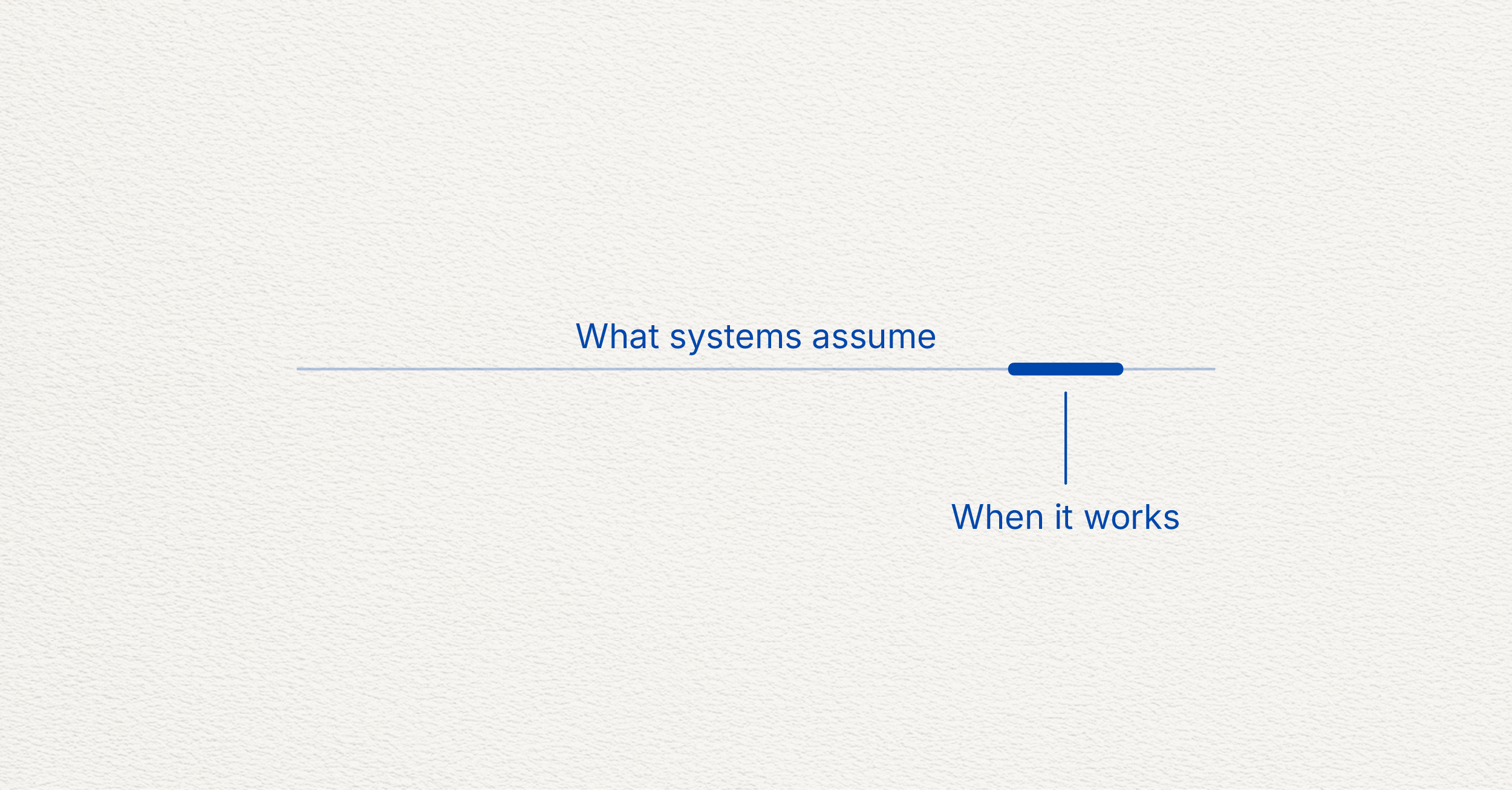
Most systems are built on a set of assumptions that don’t get stated out loud. They assume your energy is steady, your focus is available, your time is predictable. They assume you can plan once and then execute without much variation. And when those assumptions hold, the system works in the way it was designed to.
But those conditions don’t hold consistently. Energy shifts. Attention moves. Life introduces variables that weren’t part of the original plan. Even small changes can be enough to make something that felt manageable suddenly feel heavier, slower, or less clear.
So the system doesn’t break all at once. It starts to misalign.
The structure is still there, but the conditions around it have changed. And because the system wasn’t designed to adapt to those changes, it stops fitting the situation you’re actually in. What once felt straightforward starts to require more effort. What once felt automatic starts to feel forced.
Instead of adjusting the system, the pressure usually turns inward. You try to get back to how things were at the beginning. You try to recreate the version of yourself that made it work the first time. You might think you need to be more disciplined, more consistent, better at following through.
That response is based on the idea that the system itself is stable, that it should work regardless of changing conditions. And if it doesn’t, the conclusion becomes that you’re the unstable part.
But if a system only works when everything lines up—when your energy is high, your schedule is clear, your focus is available—that’s not a system that holds under real conditions. That’s something that works in a narrow window, and most of the time, you’re not operating inside that window.
There are interruptions. Shifts in energy. Competing priorities. Days where things take longer than expected or require more effort than you planned for. None of that is unusual. It’s just what real days look like.
But if the system doesn’t account for it, it’s going to keep breaking. Not because you failed to follow it, but because it wasn’t designed to hold variation.
That changes how the pattern makes sense. The starting strong, the drop-off, the reset, the trying again—it’s not random. It’s what happens when something works temporarily but doesn’t adapt to changing conditions.
And once you see that, the question shifts. Away from trying to stabilize yourself, and toward looking more closely at what the system actually requires in order to work. What conditions does it depend on? And are those conditions consistently available?
Because if they’re not, then the pattern isn’t coming from a lack of follow-through. It’s coming from a mismatch—a mismatch between how the system is structured and how your actual days unfold.
And that mismatch doesn’t get resolved by trying harder. It just gets repeated.
Seeing that doesn’t immediately change anything. The same constraints are still there. The same fluctuations still happen. But it removes one layer that tends to sit on top of all of it—the assumption that something is wrong with you.
Because when a system only works under specific conditions, it’s going to stop working as soon as those conditions shift.
No matter who’s using it.
Listen / Explore:
Engage in the format that fits your energy.
Listen: The podcast explores this idea in audio form, designed to be followed from start to finish.
Explore: The free guide offers optional prompts and tools you can use selectively.
Neither are required. Choose what supports you.
