What Feels Like Inconsistency Is Often a Structural Mismatch
At first, it looks like separate problems.
You can’t keep up with what you planned. You lose momentum partway through the week. Things that felt clear a few days ago start to feel heavier, like they require more effort than they should. So you try to fix each one. Be more consistent, be more disciplined, get back on track. Each moment gets treated as something that needs to be corrected.
But over time, a pattern starts to form.
Not all at once. More like something you notice out of the corner of your eye. The same cycle repeating in slightly different ways. You start with something that makes sense. You follow through. It works, at least for a while. And then something shifts. Not dramatically, just enough that what felt manageable no longer fits the same way.
It’s easy to interpret that shift as inconsistency. Or a lack of follow-through. Or something about the way you’re approaching things that needs to be improved. That interpretation feels reasonable, especially when each moment is looked at in isolation.
But that interpretation depends on an assumption.
That the conditions you’re working within are stable.
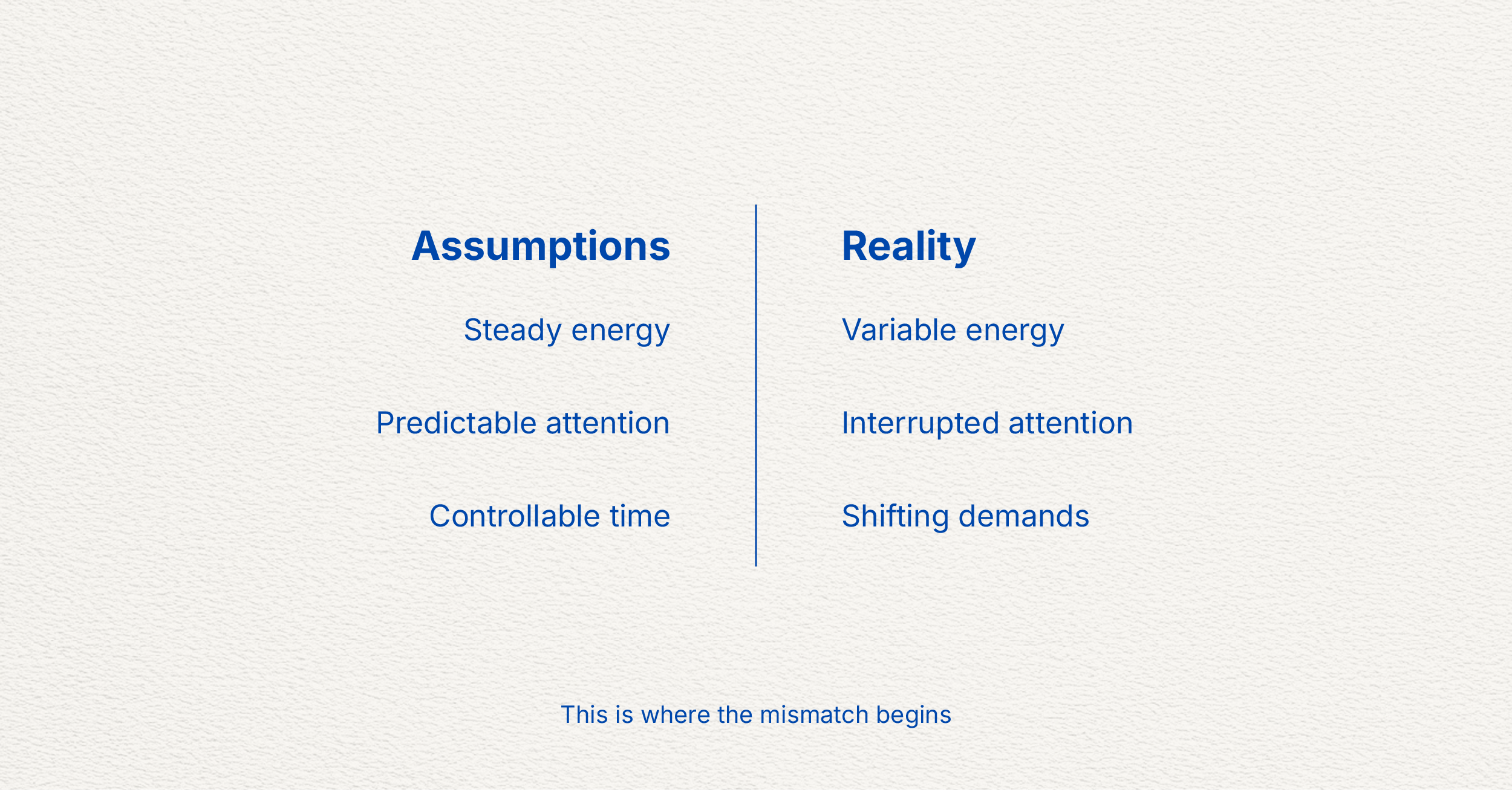
Most systems are built on that assumption, even when it isn’t stated directly. They assume that your energy is steady, that your attention is predictable, and that your time can be controlled. When those conditions are there, the system works the way it’s supposed to. Plans are easier to follow, effort translates more directly into progress, and momentum carries forward without much resistance.
But those conditions don’t consistently hold.
Energy changes depending on the day, or even within the same day. Attention gets interrupted or pulled in different directions. Time shifts in ways that aren’t always visible ahead of time. Not occasionally, but over and over. And when those conditions shift, the system doesn’t break all at once. It starts to drift.
Things take longer than expected. Decisions require more effort. What felt clear and manageable a few days ago starts to feel heavier. From the outside, it can look like inconsistency. From the inside, it often feels like trying to get back to something that was just working.
The pattern repeats because the assumption stays the same.
Each reset is built on the idea that this time the conditions will hold. That energy will stay consistent, that attention will remain available, that time will behave as planned. So the system keeps asking for something that isn’t reliably there, and the mismatch keeps showing up in slightly different ways.
What looks like inconsistency is often the result of that mismatch.
Not a failure to follow through, but a structure that depends on conditions that aren’t consistently present.
Seeing that doesn’t immediately change the constraints. Energy will still vary. Attention will still get interrupted. Time will still shift. The structure around you may stay exactly the same.
But it changes how the pattern is interpreted.
Instead of trying to correct yourself within the same setup, you start to notice the setup itself. What it assumes. What it requires. What happens when those conditions aren’t met. That awareness doesn’t resolve the pattern right away, but it makes it visible.
And once it’s visible, it becomes harder to keep reading it the same way.
Not because anything has been fixed.
But because something is clearer now.
Listen / Explore:
Engage in the format that fits your energy.
Listen: The podcast explores this idea in audio form, designed to be followed from start to finish.
Explore: The free guide offers optional prompts and tools you can use selectively.
Neither is required. Choose what supports you.
