Who Controls the Water We Swim In?
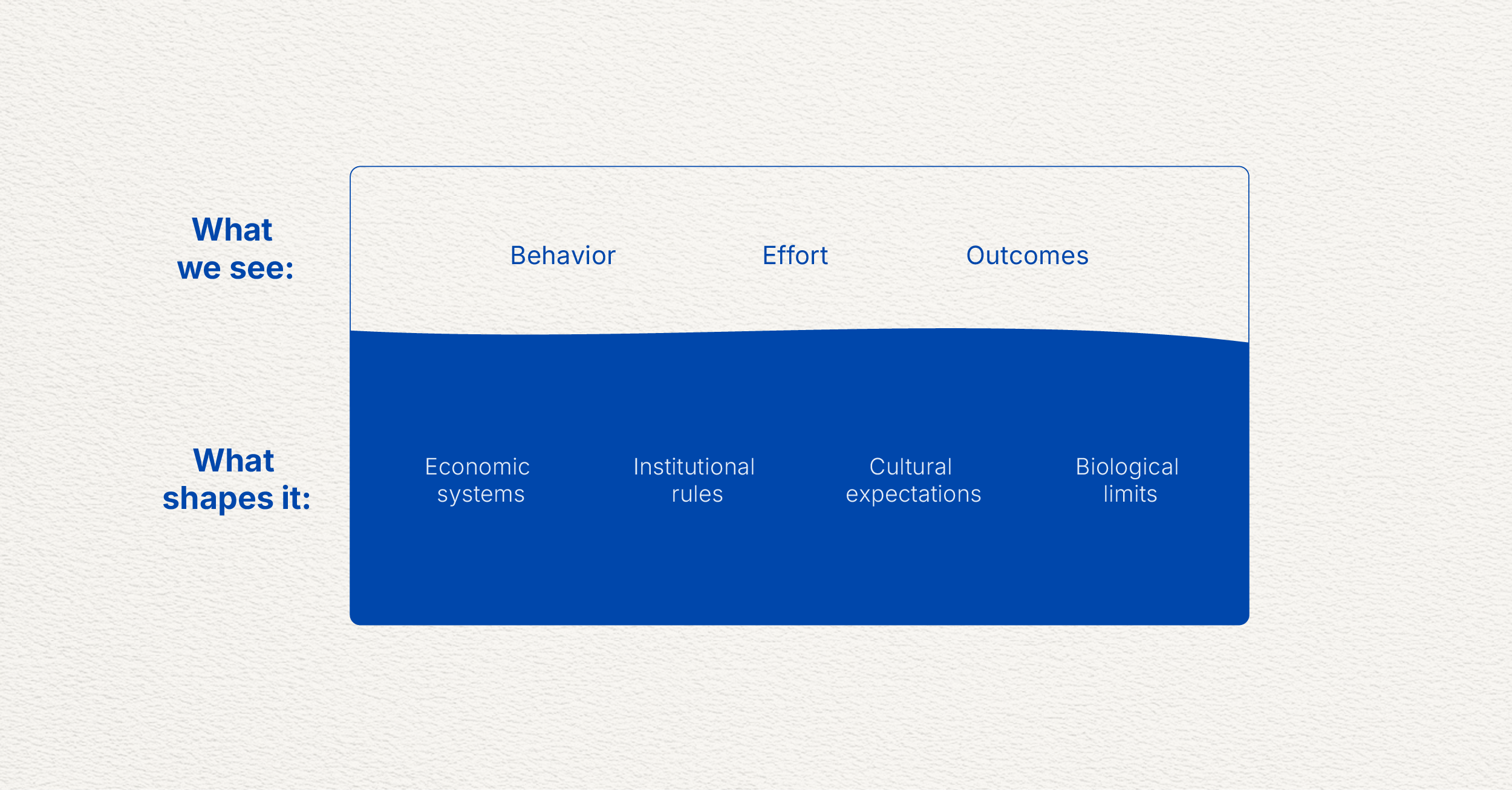
The ocean does not move randomly. Its surface is shaped by wind. Its tides are shaped by gravitational pull. Its deeper currents are shaped by differences in temperature and salinity that most of us will never see. From the shore, it can look repetitive and manageable—waves rolling in, horizon steady—but that surface movement is only a fraction of what is actually happening. Most of the motion is generated far below eye level. Depth determines direction long before the surface reveals it.
We tend to think about our lives at the surface level. We see behavior. We see effort. We see outcomes. Someone looks organized. Someone looks exhausted. Someone appears disciplined. Someone appears inconsistent. But much of what shapes those outcomes begins upstream of conscious choice. Surroundings influence movement before intention has a chance to intervene. In physics, objects move according to forces acting upon them. In human systems, behavior moves according to conditions—economic incentives, institutional rules, cultural expectations, biological thresholds. Agency exists. But it does not exist in a vacuum.
Consider what is treated as normal. A forty-hour workweek is standard. In many households, two incomes are required to remain financially stable. School schedules are shorter than most full-time shifts. Childcare fills gaps at additional cost. Commutes extend the day further. By the time dinner arrives, the available energy for cooking, exercising, or “self-improvement” has already been shaped by structures set long before any individual made a personal plan. When fatigue follows, it is easy to interpret it as a failure of discipline. It is harder to examine the current itself.
Food environments operate similarly. Most grocery stores are designed around scale, efficiency, and shelf stability. Highly processed foods are engineered to be inexpensive, durable, and hyper-palatable. Marketing reinforces convenience. Time scarcity reinforces convenience. And then the responsibility for health is placed squarely on the end user. Make better choices. Try harder. Be consistent. But choices are always made within context. What is affordable, available, culturally normalized, and time-compatible exerts pressure long before willpower enters the equation. The surface shows an individual selecting a product. The depth holds supply chains, agricultural subsidies, labor demands, and profit incentives.
None of this eliminates personal responsibility. It clarifies its boundaries.
Outcomes are rarely produced by a single force. They emerge from interaction. A long work schedule does not exhaust every body equally. Repetitive sound can soothe one nervous system and overwhelm another. The same environment produces different effects depending on biology, history, and capacity in that moment. It is not the structure alone that determines behavior, and it is not the individual alone either. It is the relationship between the two. The current matters. So does the strength and condition of the person navigating it.
Problems arise when depth is mistaken for surface. When structural strain is misread as personal weakness. When upstream forces are invisible, downstream struggle is moralized. Laziness. Poor choices. Lack of motivation. These explanations feel clean because they keep the analysis shallow. They ignore the fact that much of life unfolds inside systems we did not design and cannot individually overhaul.
There is a line that has circulated for nearly a century known as the Serenity Prayer: “Grant me the serenity to accept what cannot be changed, the courage to change what can, and the wisdom to know the difference.” The most difficult portion is not acceptance. It is not courage. It is the difference. Discernment is the ability to accurately attribute cause. What is a tide? What is a technique problem? What is an environmental constraint? What is a skill gap? Without discernment, effort is misdirected. Energy is spent fighting currents that require adaptation rather than force.
The ocean offers a useful image here. From above, it looks uniform. Beneath the surface, it is layered. Light fades quickly. Pressure increases. Entire systems operate in darkness. A person standing at the shore can judge only what is visible. But depth determines movement long before waves reach land. The more accurately we understand depth, the less likely we are to misinterpret surface motion.
The same is true of human life. As awareness of structural, biological, and cultural currents increases, misattribution decreases. We begin to see where effort is effective and where it is simply exhausting. Some currents can be redirected—habits adjusted, schedules renegotiated, skills developed. Some currents require adaptation—lowered expectations during constrained seasons, redesigned routines that match actual energy. And some currents are simply larger than individual will. Recognizing scale is not resignation. It is orientation.
Maturity is not the ability to command the ocean. It is the ability to read the water.
Listen / Explore:
Engage in the format that fits your energy.
Listen: The podcast explores this idea in audio form, designed to be followed from start to finish.
Explore: The free guide offers optional prompts and tools you can use selectively.
None are required. Choose what supports you.
