Why Plans Stop Working in Real Life
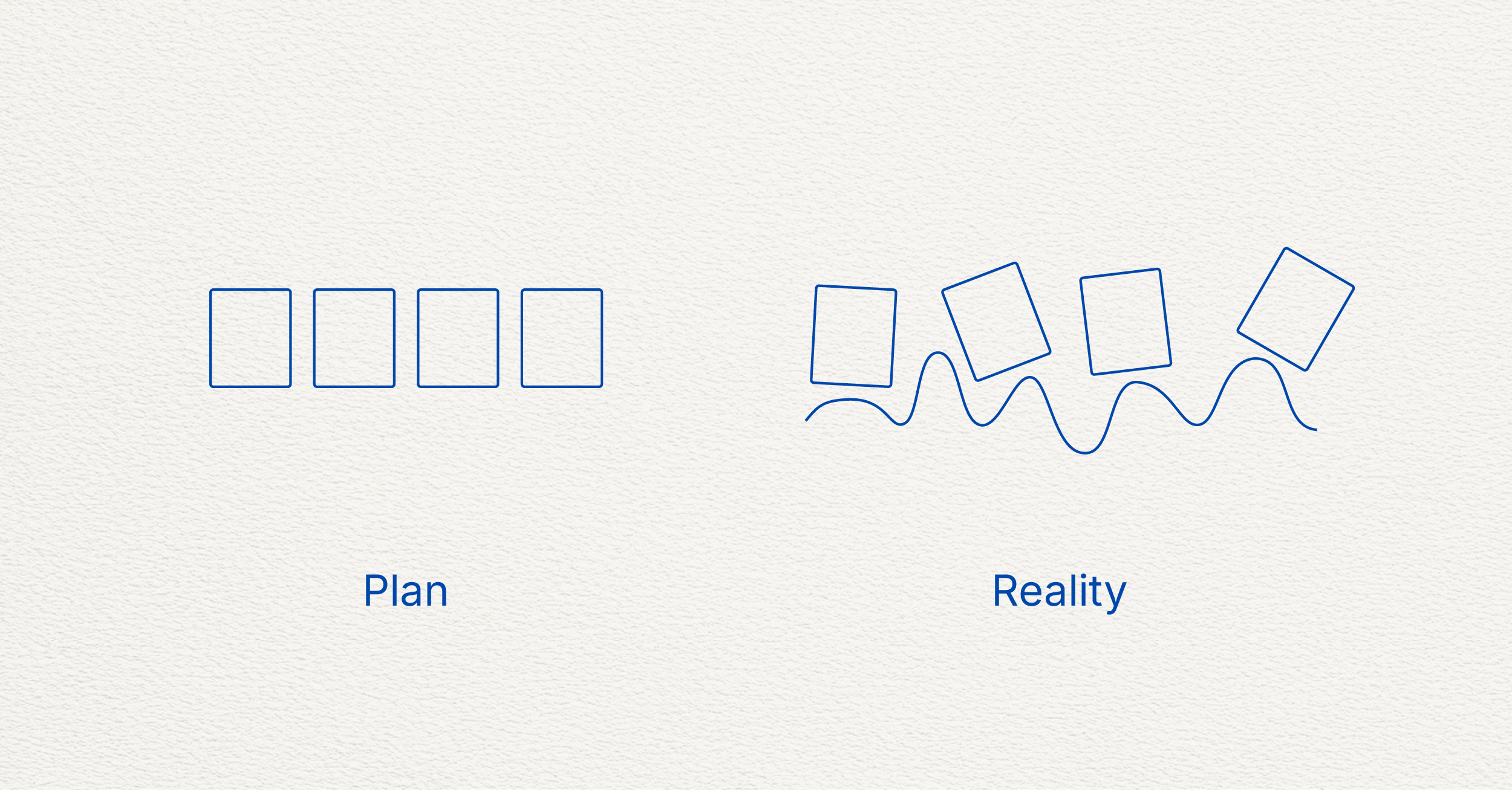
You make a plan when you’re clear.
You think through what needs to happen, organize the steps, maybe even feel relieved—because now there’s structure. On paper, it makes sense. Sometimes it makes perfect sense.
And then later comes the moment when real life is supposed to meet that plan.
Your energy is different. Your attention is split. Something unexpected happened earlier in the day. The task feels heavier than it did when you mapped it out. What looked straightforward in a clear moment now feels harder to carry.
For a lot of people, this is where the interpretation turns inward.
The plan must not be good enough.
I need more discipline.
Why can’t I just do what I said I’d do?
But often, that isn’t the real issue.
Many plans are built around a version of you that won’t consistently exist.
They’re created during moments of relative clarity—when you have enough distance, enough cognitive access, enough energy to think structurally. But execution doesn’t always happen under those same conditions.
Execution happens inside actual life.
Inside interruptions.
Inside sensory load.
Inside stress.
Inside caregiving.
Inside fluctuating capacity.
Inside brains and bodies that may already be working harder than expected just to navigate the day.
And the less margin a person has (neurologically, emotionally, financially, logistically), the more obvious this becomes.
Because humans do not operate under identical internal conditions from one moment to the next.
And for people whose minds or lives already require more adaptation than many systems account for, this mismatch can become constant.
So when a plan only works under specific conditions, inconsistency is not always a character flaw.
Sometimes it’s a design flaw.
This is where a lot of planning systems quietly break down.
They assume stable access to focus, time, motivation, and follow-through. They’re often built for ideal conditions—or at least predictable ones.
But many people are trying to function inside systems that were not designed with variable energy, sensory differences, executive dysfunction, chronic stress, caregiving load, or reduced recovery time in mind.
So when those systems stop working, the common response is usually to double down.
More structure.
More rules.
More optimization.
A better planner.
A tighter routine.
But more structure does not automatically create more support.
If the system itself was built around unrealistic consistency, increasing rigidity can actually increase failure.
Not because the person failed. Because the design still isn’t accounting for reality.
This is why some of the most “logical” systems can still feel impossible to sustain.
They make sense intellectually. But they don’t always translate under lived conditions.
A usable system has to account for the fact that your capacity will change.
It has to ask:
What happens when today is heavier?
What happens when energy drops?
What happens when life interrupts?
What happens when the version of me who made this plan is not the exact same version who has to carry it out?
That shift matters.
Because sustainable systems aren’t the ones built for ideal days.
They’re the ones that still hold on real ones.
For many people, that realization can be the difference between endlessly trying to force themselves into better systems…
…and finally learning to build better systems for themselves.
If you’re realizing your life may need more humane structure—not just better discipline—I put together a free Life Design Starter Kit to help people begin thinking this way.
If this idea resonates, I also explore it further in this week’s podcast episode—looking more closely at the difference between top-down planning and bottom-up reality, and why that mismatch can quietly shape whether a system actually holds.
