Why Small Tasks Can Become So Hard
The hidden cost of transition, uncertainty, and why “having time” is not always the same thing as being able to act
“You had time. Why didn’t you just do it?”
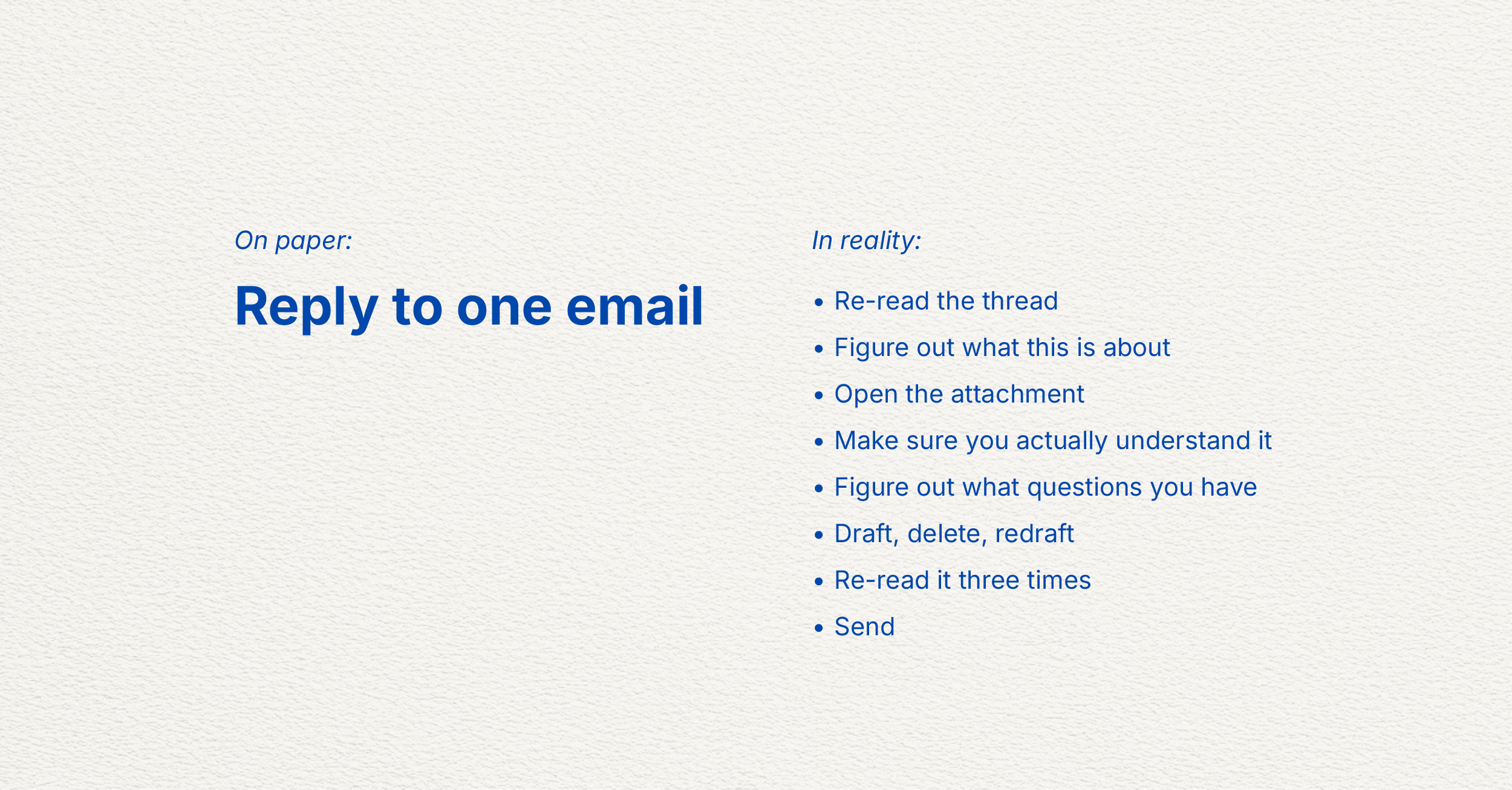
For many people, that question sounds completely reasonable. If something only takes 10 minutes—and you had 20—why is it still undone? On paper, the math seems simple.
But this way of thinking often assumes the visible task is the full task. And often, it isn’t.
Because many small tasks are not hard solely because of the task itself. They are hard because of what it takes to get your mind into the right mode to do them.
That distinction matters more than most people realize.
A task might technically be small: send the text, make the call, book the appointment, download the paperwork, respond to the email. From the outside, those things may look like quick actions.
But visible execution time is not always the full cognitive cost.
Often, there are invisible layers underneath. What exactly do I say? Where do I find the right document? What are the steps? Am I forgetting something? Do I have enough time to fully get into this? What if this becomes more complicated than I expect? What if I start this and then get interrupted?
Suddenly, the task is no longer just the task.
Now there is also orientation. And orientation has a cost.
The Hidden Cost Most People Don’t See
For some people, switching tasks feels like changing lanes. For others, it feels more like turning a ship.
Often, the hardest part is not doing the thing—it’s shifting into the mental state required to do it. From parenting mode to computer mode. From creative work to admin. From one client to another. From resting to problem-solving. From uncertainty to action.
That shift can require far more energy than the task itself appears to justify.
And when people around you are only measuring the task by how long it should technically take, this hidden cost can become almost invisible.
This is why “you had enough time” and “you had enough usable capacity” are not always the same thing.
A free 20-minute pocket in your day may look available from the outside. But what if you’re waiting for your child’s bus? What if you may be interrupted at any moment? What if you need to first remember where you left off? What if you need to gather five missing pieces before you can even begin?
That time may technically exist.
But cognitively, it may already be occupied.
This is where many traditional conversations about productivity start to fall apart, because they often measure visible minutes while overwhelm is often shaped far more by hidden transition costs.
Why Unclear Steps Can Make Small Things Feel Huge
One of the biggest amplifiers of transition cost is uncertainty.
Not knowing what to say. Not knowing where to start. Not knowing the exact steps. Not knowing how big something will become once you begin.
This is why tasks that seem “easy” to other people can feel disproportionately hard.
Not necessarily because they are objectively difficult—but because unclear steps require your brain to build the map while also trying to travel it.
That is a very different experience than following a known path.
This is also why written steps, checklists, templates, or highly structured systems can feel so helpful. From the outside, these tools can look excessive. But for many people, they are not about perfection.
They are about reducing orientation cost.
They lower the amount of mental energy required to begin because when the steps are already externalized, your brain does not have to spend as much energy generating them from scratch.
This can be the difference between “I should do this” and “I can actually start.”
Why Overplanning Often Makes More Sense Than People Realize
This is also where chronic overplanning can start to make more sense.
Overpreparing is often framed as anxiety, perfectionism, or unnecessary complexity. Sometimes it is.
But sometimes, overplanning is also an attempt to reduce future uncertainty before uncertainty becomes expensive.
If uncertainty carries a high cognitive cost, planning can become protective.
Packing extra clothes, bringing too many snacks, mapping every possible step, writing overly detailed plans—these things can look excessive from the outside, but internally, they may be attempts to reduce the number of expensive unknowns you’ll have to process later.
Not necessarily because disaster is likely—but because adapting in real time may feel more cognitively draining than preparing in advance.
This does not mean overplanning is always helpful. Sometimes it becomes exhausting in its own right.
But it often makes more sense when you understand what problem it may actually be trying to solve: reducing transition cost by reducing uncertainty.
Why This Is Often Misread
When people do not see transition cost, they often default to simpler explanations.
They’re procrastinating. They’re lazy. They’re overthinking. They just need to do it.
But these explanations often miss something important.
Sometimes, a task can be genuinely easy on paper and still hard to start.
Not because someone lacks intelligence. Not because they do not care. Not because they are unwilling.
But because the hidden work of shifting, orienting, clarifying, and preparing can be much bigger than the visible task itself.
A More Useful Question
Instead of only asking, “How long does this take?” it may sometimes be more helpful to ask, “What does it take to get into this?”
Because execution time and entry cost are not always the same thing.
And for many overwhelmed people, the entry cost is the real barrier.
What we measure—and what we miss
Sometimes the task is small. But the transition is not.
And when we only measure visible time, we can miss the invisible complexity shaping whether something feels doable at all.
This is one reason small things can become so hard.
Not always because the task itself is too much—but because the hidden cost of getting there can be much bigger than it seems.
If this way of looking at time and capacity feels familiar, I go deeper into it in the podcast—and the Life Design Starter Kit is a simple place to start if you want to begin noticing where tension is showing up and what it might be telling you.
